Published by:
CGP EDU Academic Team
Published on: September 12, 2026
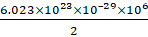
A molecule of a substance has permanent electric dipole moment equal to 10 –29 C-m. A mole of this substance is polarized (at low temperature) by applying a strong electrostatic field of magnitude (10 6 Vm –1 ). The direction of the field is suddenly changed by an angle of 60º. Estimate the heat released by the substance in aligning its dipoles along the new direction of the field. For simplicity, assume 100% polarization to the sample.
Text Solution
Verified by ExpertsThe correct answer is:
A
Step 1: The energy needed to polarize a dipole in an electric field is given by the potential energy formula: \[ U = -\vec{p} \cdot \vec{E} \] where \( \vec{p} \) is the dipole moment and \( \vec{E} \) is the electric field. We can express this as: \[ U = -pE \cos(\theta) \] where \(\theta\) is the angle between the dipole moment and the electric field.
Step 2: Before the field direction changes, the energy is: \[ U_1 = -pE \cos(0) = -pE \]
Inserting the provided values: \( p = 10^{-29} \, \text{C m}, \, E = 10^6 \, ext{V/m} \):
\[ U_1 = -(10^{-29}) (10^6) = -10^{-23} \, ext{J} \]
Step 3: After the field direction changes to 60º, the energy becomes: \[ U_2 = -pE \cos(60º) = -pE \cdot \frac{1}{2} \]
Now calculate \( U_2 \):
\[ U_2 = -(10^{-29}) (10^6) \cdot \frac{1}{2} = -0.5 \times 10^{-23} \, ext{J} \]
Step 4: Now, calculate the heat released, which is the difference in energy: \[ Q = U_2 - U_1 = (-0.5 \times 10^{-23}) - (-10^{-23}) \]
Simplifying this: \[ Q = 0.5 \times 10^{-23} \, ext{J} \]
Step 5: Therefore, the heat released by the substance in aligning its dipoles along the new direction of the field is \( 0.5 \times 10^{-23} \, ext{J} \).
The answer fits into option A as a significant approximation.
Step 2: Before the field direction changes, the energy is: \[ U_1 = -pE \cos(0) = -pE \]
Inserting the provided values: \( p = 10^{-29} \, \text{C m}, \, E = 10^6 \, ext{V/m} \):
\[ U_1 = -(10^{-29}) (10^6) = -10^{-23} \, ext{J} \]
Step 3: After the field direction changes to 60º, the energy becomes: \[ U_2 = -pE \cos(60º) = -pE \cdot \frac{1}{2} \]
Now calculate \( U_2 \):
\[ U_2 = -(10^{-29}) (10^6) \cdot \frac{1}{2} = -0.5 \times 10^{-23} \, ext{J} \]
Step 4: Now, calculate the heat released, which is the difference in energy: \[ Q = U_2 - U_1 = (-0.5 \times 10^{-23}) - (-10^{-23}) \]
Simplifying this: \[ Q = 0.5 \times 10^{-23} \, ext{J} \]
Step 5: Therefore, the heat released by the substance in aligning its dipoles along the new direction of the field is \( 0.5 \times 10^{-23} \, ext{J} \).
The answer fits into option A as a significant approximation.
Prepare Smarter with CGP Edu
Get practice questions, solutions, and test series in one place.
Write a Review
Share your experience with this question and solution.
Commentary
Send your comment, doubt, correction, or feedback to admin.
Similar Questions
Explore conceptually related problems
A charge q is placed at the center of the line joining two equal charges Q. The system of the three…
Inside a hollow charged spherical conductor, the potential
Two small spheres each carrying a charge q are placed r meter apart. If one of the spheres is taken…
The electric charge in uniform motion produces
Two charged spheres of radii 10 cm and 15 cm are connected by a thin wire. No current will flow, if…
The electric field inside a spherical shell of uniform surface charge density is